9583 Sergeant
JOHN JOHNSTON
Royal Engineers
By
Lieutenant
Colonel Edward De Santis, MSCE, P.E., MInstRE
U.S. Army Corps of Engineers
(July 2022)
Figure 1.
Crest of the Corps of Royal Engineers (Victorian)
(Image courtesy of Stuart Gase)
This research dealing with Sergeant Johnston’s military service has been compiled primarily from his military service papers contained in File WO97/3165 at the Public Record Office, London.[1] The information concerning his early life and family information was obtained from a splendid family tree posted on Ancestry.com by Kent Wilson.[2] In addition, Johnston and his family were found in every census of Scotland, Wales and England from 1851 to 1911.
The original research of Sergeant Johnston’s life was completed in 2000
following the author’s acquisition of his Army Long Service and Good Conduct
medal. That initial research
amounted to only 4½ pages of typed text. As
will be seen the intervening 22 years and the development of internet sources
has greatly increased the author’s knowledge of Johnston’s life although in
some areas there is doubt regarding the accuracy of the information.
Early Life
John Johnston was born about 1845 in Bathgate in the County of Linlithgow,[3] Scotland. No birth or baptism records for him could be found, so his year of birth is based on his stated age in the 1851 census and 1861 census. His year of birth, as stated in his military records would be 1848, but this appears to be in error.
John was the son of Archibald Johnston (1811-1883) and Elizabeth Johnston, née Kinnear (1816-1889). He resided in Bathgate until the time of his enlistment in the Army As a young lad he worked as a joiner for a Mr. John Rodgers of Bathgate. John was not married at the time of his enlistment in the Army.[4]
Johnston enlisted in the Militia Volunteers at Dunbar, Scotland on 18 June 1866. At the time of his enlistment he was 18 years and 9 months old. The unit of the Scottish Volunteer Force in which he enlisted was, at that time, known as the Haddington Artillery Militia. The establishment of this small unit (battery) was 69 men. The unit formed part of the 1st Corps of the Scottish Volunteer Force.[5] Johnston served in the Haddington Artillery Militia for a period of about a year and a half when he decided to enlist in the Regular Army.
Family
Information
Archibald and Elizabeth Johnston had a daughter and a son in addition to
John. Their first child was a
daughter, Elisabeth, born in 1843. John
was their second child and he was followed by Archibald in 1849 who died in
1853. The Johnstons then had another
son in 1855 who they again named Archibald, probably so they would have a son
with their father’s name. Sadly
their second Archibald died before he reached the age of one year.
The composition of the Johnston family in 1851 was as shown in the table
below.
1851
Census of Scotland
|
Address:
Main Street, Bathgate, West
Lothian |
|||||
|
Name
and Surname |
Relation |
Marital
Status |
Age |
Profession
or Occupation |
Birthplace |
|
Archibald
Johnston |
Head |
Married |
38 |
Merchant |
Torphichen, |
|
Elisabeth
Johnston |
Wife |
Married |
33 |
|
Bathgate, |
|
Elisabeth
Johnston |
Daughter |
|
8 |
|
Bathgate, |
|
John
Johnston |
Son |
|
8 |
|
Bathgate, |
|
Archibald
Johnston |
Son |
|
2 |
|
Bathgate, |
|
Mary
Murra |
Servant |
|
12 |
House
Servant |
Ireland |
NOTE: There are some discrepancies regarding the spelling of the name Elisabeth in some of the census, where it is sometimes spelled with an “s” and other times with a “z.” The spelling with a “z” is the typical spelling in English; however, the Scots frequently spelled it with an “s.”
When the 1861 census was taken in Scotland the household was much reduced
in size, consisting only of Archibald (54), Elisabeth (46) and John (16).
The Johnstons were then living at 33 Livery Street in Bathgate.[6]
Both sons named Archibald were deceased in 1861 and apparently the family
could no longer afford or no longer needed a domestic servant.
In 1861 Archibald Johnston was listed as a Railway Porter and not as a
Merchant as he had been in 1851.
When
John Johnston enlisted in the Scottish Volunteer Force in 1866 he was described
as being 5 feet 7-1/2 inches tall with a fair complexion, blue eyes and light
brown hair. When he was examined on
28 January 1868 for his enlistment into the Royal Engineers he was described as
being 67-1/4 inches tall, weighing 144 pounds, having a chest measurement of 36
inches, and good muscular development. His
pulse was 72 beats per minute and his respiration was measured at 18
inspirations per minute. The
examining surgeon noted that he had no marks indicating a previous infection of
small pox. The surgeon also noted no
previous evidence of a vaccination. Johnston
subsequently was vaccinated on 31 January 1868 with the result being described
as “perfect.”
4. ENLISTMENT AND
TRAINING
Enlistment
On 18 January 1868 John Johnston went to Glasgow and presented himself to Sergeant Thomas Brown, a Recruiting Sergeant of the 26th Regiment of Foot.[8] Sergeant Brown duly enlisted Johnston in the Royal Engineers on that date and was found fit for military service by Major George Moore, Subdivision Officer of the Recruiting Service in Glasgow.[9] Johnston swore the Oath of Attestation on 20 January and his enlistment was approved the following day. As a Joiner in civil life his trade would have been one that the Royal Engineers were pleased to welcome, as Joiner was a Corps Trade. Following the approval of his enlistment he was posted to the School of Military Engineering at Chatham, Kent for his recruit training.
Johnston’s service record indicates that his enlistment in the Royal Engineers was fraudulent, although this was not found out until sometime later. It appears that he failed to obtain his discharge from the militia before enlisting in the Regular Army.
Training
Johnston arrived at Chatham on 27 January 1868 to receive his training as an engineer soldier.[10] His training began with the basics that were required for each man to learn to be a soldier. This involved military customs, the wearing of his uniform and insignia, military discipline and the use, care and maintenance of his rifle. Following a period of basic training, Johnston then received the training necessary to make him an engineer soldier. This involved such field engineering subjects as tunnelling, trench-building, bridging, the use of explosives and other skills necessary to support the infantry and artillery in the field. It appears that he also received some additional training in surveying, as his subsequent long-term posting to the Ordnance Survey would indicate that his service was specialized in this field.
5.
POSTINGS AND ASSIGNMENTS
Putting together a narrative of John Johnston’s postings is difficult because his service records, although available to the author, did not provide much in the way of specific places and dates of his service. Other than the fact that he served with the Ordnance Survey, the units he served with and the dates that he served in them have been difficult to pin down. Dates and units have been found in a number of individual documents that contradict each other. The following narrative is the best that could be derived by author from the information discovered regarding Johnston’s service.
Chatham
(1868)
Sergeant Johnston served a total of 21 years and 6 days in the Royal Engineers, all of his service being at home in England. His service papers show that following his recruit training at Chatham, he was temporarily posted to the 35th Depot Company at Chatham. This temporary posting was due to the need to treat him for scabies. He was admitted to hospital on 28 April and was released on 30 April 1868. Upon his release from hospital he was assigned to Ordnance Survey duties, duties that included mapping of various portions of the United Kingdom. If he was posted to Scotland following his release from hospital, then it is likely that he arrived there in May of 1868.
Scotland
(1868-1871)
The
1871 Scotland Census, taken on 2 April 1871, shows Sapper John Johnston with the
Ordnance Survey residing as a boarder in the home of Norman and Mary McLeod of
Rose Street in Thurso, Caithness, Scotland.
Another boarder in the home at that time was Mr. Alexander James Scally a
Civil Assistant with the Ordnance Survey. The
specific unit in which he was serving at the time has not been determined,
however it is most likely that he worked on surveys to develop maps of some area
of Scotland. When he arrived for
duty in Scotland could not be determined from available records.
Bristol (1871)
Johnston’s Medical History sheet shows that he arrived at Bristol on 20 November 1871. At that time the 16th (Survey) Company was stationed at Clifton, near Bristol, so it is likely that he was posted to that unit. How long he served in Bristol could not be determined, but it appears to have been a short time broken up by some time in Southampton as described below.
Southampton
(1871-1878)
War Office records also indicate that 9583 Sapper John Johnston was serving in the 19th (Survey) Company at Southampton, Surrey during the period from 1 April 1871 to 30 June 1871.[11] So during the year 1871 we have Johnston in Caithness, Southampton and Bristol serving in survey companies of the Royal Engineers. Since Southampton was the headquarters for the Ordnance Survey, it is likely that he could have served there for as long as seven years with some time spent at Aldershot, as discussed below.
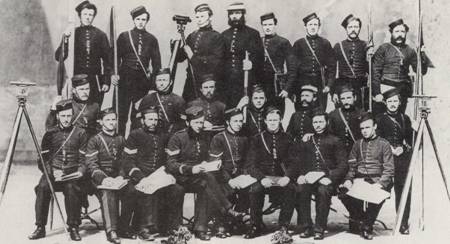
Figure 2. Men of the
Ordnance Survey, circa 1868.
(Photograph courtesy of Regiment magazine)
Aldershot (1878-1879)
According to the baptism certificate of his daughter, Mary Elizabeth, Johnston was serving with the 17th Field Company, Royal Engineers on 7 April 1878, the day of her baptism. This is rather unusual, as a man who was primarily assigned survey duties rarely was posted to a field company; that is, a company in a division whose primary mission was to provide field engineer services to artillery, cavalry and infantry units.
Bristol
(1879-1881)
By late 1879 he was back in Bristol, probably with the 16th (Survey) Company, as he re-engaged there on 9 December 1879 to complete 21 years of service.[12] In 1881 the census of Wales indicates that Johnston and his family were living in Pontypool, in the sub-district of Llanglbby.
1881 Wales Census
|
Address:
Royal Oak Cottage, Lower
Llanvrechva, Monmouthshire |
|||||
|
Name
and Surname |
Relation |
Marital
Status |
Age |
Profession
or Occupation |
Birthplace |
|
John
Johnstone |
Head |
Married |
33 |
Corporal,
Royal Engineers |
Scotland |
|
Kezia
Johnstone |
Wife |
Married |
34 |
|
St.
Georges, |
|
Mary
E. Johnstone |
Daughter |
|
3 |
|
St.
Georges, |
|
Sarah
K. Johnstone |
Daughter |
|
1 |
|
Newport, |
NOTE: The Johnston surname was misspelled as Johnstone in the census return.
Pontypool
(1881-?)
His service in Wales is rather vague. Other than the 1881 census data there is no information in his service records to indicate that he ever served in Wales. He may have returned to Bristol and the 16th (Survey) Company where he served the remainder of his career on duties associated with the Ordnance Survey of England, although this is not at all certain.
Bedford
(dates unknown)
At some point Johnston was posted to Bedford where he was serving at the
time of his discharge from the Army. Johnston’s
service records show that he had no overseas or campaign service.
6.
MEDICAL INFORMATION
During his period of service in the Royal Engineers, Johnston’s medical history indicates only one period of hospitalization. He was admitted to the military hospital at Chatham, Kent on 28 April 1868 with a case of scabies. His infection was treated for three days and he was released and returned to duty on 30 April.
6. RELEASE FROM SERVICE
Johnston’s service records were reviewed on 17 January 1889 by the Assistant Superintendent, Royal Engineer Records, for the purpose of determining his eligibility for discharge. On that date his total service with the Colours was reckoned at 20 years and 363 days. After eight additional days of service, Sergeant Johnston was discharged at Bedford on 25 January 1889 in consequence of the termination of his second period of limited engagement. At the time of his discharge he had completed 21 years and 6 days of service. Because of his fraudulent enlistment, Johnston had forfeited his initial 3 years and 149 days of service towards his good conduct pay[13] and pension. This service was restored to him, however, on 21 June 1876; hence, his total service requirement for pension remained at 21 years. His Statement of Services and Discharge were certified by Colonel C.W. Wilson, R.E. Johnston’s total service with the Royal Engineers was reckoned as shown in the tables below.
Location |
Period
of Service |
|
Chatham |
18 January 1868 – 19 November 1871 |
|
Bristol |
20 November 1871 – 25 January 1889 |
NOTE: His periods of service in Scotland, Southampton, Aldershot, Bedford and Wales are not included in the table above as the specific dates that he served at each location are not known.
Location |
Period
of Service |
|
Home |
21 years |
|
Abroad |
None |
|
Total Service |
21 years |
________________________________________________________________
The following sections are presented in tabular form to summarize
Johnston’s promotions,
appointments, military training and qualifications and the medals that he was
awarded during his time in the Army. They
are provided to give the reader easy access to these aspects of his military
career. The tables are followed by
sections dealing with his marriage, personal information and post-service life.
__________________________________________________________________________
7.
PROMOTIONS, CONDUCT AND EDUCATION
Promotions:
During his period of service in the Royal Engineers, John Johnston was
promoted as indicated in the following table:
|
Dates
of Promotion |
Rank |
|
Sapper |
20 January 1868 |
|
Lance Corporal |
1 June 1876 |
|
2nd Corporal |
3 January 1878 |
|
Corporal |
6 August 1879 |
|
Sergeant |
18 October 1883 |
NOTE: The Johnston family tree and the obituary quoted at the end of this narrative both indicate that Johnston was Sergeant Major. The family tree entry probably came from the obituary. His service record shows that he was a Sergeant when he was discharged.
Conduct: During his period of service in the Royal Engineers, Sergeant Johnston received the following Good Conduct Badges and pay:
|
Date
of Award |
Badge
and Pay |
|
18 June 1871 |
Awarded Good Conduct Pay at the rate of 1.d. |
|
31 March 1876 |
Forfeited Good Conduct Pay for fraudulent enlistment from the militia. |
|
21 June 1876 |
Good Conduct Pay at the rate of 1.d. restored. |
|
20 January 1874 |
Awarded Good Conduct Pay at the rate of 2.d. |
|
20 January 1880 |
Awarded Good Conduct Pay at the rate of 3.d. |
|
20 January 1884 |
Eligible for Good Conduct Pay at the rate of 4.d |
|
20 January 1889 |
Eligible for Good Conduct Pay at the rate of 5.d. |
Education:
Sergeant Johnston was in possession of a 2nd Class Certificate of
Education[15]
when he completed his military service. He
did not attend any military classes of instruction during his military service,
except perhaps for some additional training in surveying which is not indicated
in his military record.
Sergeant Johnston was awarded the Long Service and Good Conduct Medal by authority of General Order 83 of January 1886. This medal was awarded upon his completion of 18 years of service and is named to him on the rim in engraved upper case letters as follows:
9583. SERGT
JOHN JOHNSTON. R.E.
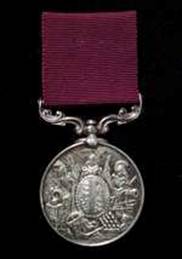
Figure 3. The Army Long Service
and Good Conduct Medal of 9583 Sergeant John Johnston, R.E.
(Image from the author’s collection)
Johnston’s Military History Sheet indicates that his intended place of residence following his discharge was Bolton, Lancashire, however the 1891 Census of England indicates that the family was residing in Bedford, Bedforshire.
1891
Census of England
|
Address:
St. Paul, Bedford,
Bedfordshire |
|||||
|
Name
and Surname |
Relation |
Marital
Status |
Age |
Profession
or Occupation |
Birthplace |
|
John
Johnston |
Head |
Married |
43 |
Licensed
Victualler |
Bathgate, |
|
Kezia
Johnston |
Wife |
Married |
44 |
|
St.
Georges, |
|
Mary
E. Johnston |
Daughter |
|
13 |
|
St.
Georges, |
|
Sarah
Johnston |
Daughter |
|
11 |
|
Newport, |
|
Charlotte
Johnston |
Daughter |
|
9 |
|
Newport, |
|
Matilda
Johnston |
Daughter |
|
4 |
|
Bedford, |
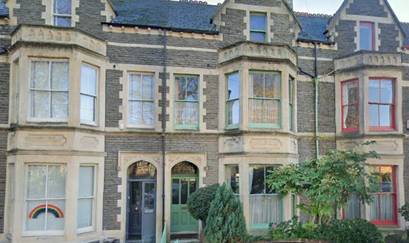
Figure 4. 35 Plasturton
Gardens, Cardiff, Wales.
(Image courtesy of Google Earth)
The 1901 Census of Wales shows John Johnston, a widower, living at the Plasturton Gardens address in Cardiff with all of his daughters. His occupation in the census is listed as Civil Engineer[16] working on his Own Account. By 1911 John Johnston, age 66, was living alone on Keysoe Road, Backnoe End, in Thurleigh, Bedforshire. By that time all of his daughters had gone out on their own.
John Johnston died on 19 December 1924 at Erskine House in Rushden, Northamptonshire. The probate of his will took place in London on 28 January 1925 with his effects of £299 6s (approximately $26,500 USD in 2022 currency) going to his daughter, Margaret Matilda Jaques (wife of Harry Francis Jaques).[17]
The following obituary was published for Johnston in a local newspaper in Thurleigh.
THURLEIGH
The death took place on 19th December at Erskine House, Rushden (the residence of his daughter Mrs. Harry Jaques) of Mr. John Johnston, who until eight weeks ago had resided at Thurleigh for 31 years. Mr. Johnston, who was 79 years of age, retired from the Army on pension with the rank of Sergt. Major[18] in the Royal Engineers forty years ago. He was then at the Curragh, Ireland. For some years he lived in Belford before taking up his residence in Thurleigh where he quickly gained the confidence and goodwill of the villagers. At the funeral on the 22nd December the Rev. C. Hemsley read the service and the mourners included his three daughters, Mrs. Roberts (Peterborough), Mrs. Thomas (Cardiff) and Mrs. H. Jaques (son-in-law), Mr. and Mrs. C. Clark, Mrs. Freeman, Mrs. Black and Mrs. Wagstaff (friends). There were several beautiful floral tributes.
Marriage
John Johnston married Kezia Evans at Clifton, Bristol on 8 May 1877, without leave. The marriage was subsequently recognized by the Army on 15 October 1887, when he was placed on the married rolls.
During the Victorian era marriage was allowed to all the staff-sergeants, to 50% of the other sergeants, 4% of the corporals and privates in the cavalry, artillery and engineers, and 3% in the infantry.[19] Corporals and men had this concession made them on condition of their having served seven years, and that they had two good conduct badges, and proved that they have 5 Pounds in the savings bank. Married soldiers could receive rations separately, and uncooked, and if the man was engaged on duty away from his family, he was paid 4.d. a day for his wife and 1-1/2d a day for each child.”[20]
A man who married without permission had a hard time indeed, for his wife and children were denied quarters of any sort and were given no extra rations; the wife had to work or starve. Kezia Johnston had to live under these conditions from 8 May 1877 to 15 October 1887.
Women on the strength had (to use the official language) ‘the privilege
of washing for their respective companies.’
They might thereby earn a halfpenny per day per customer.
Some worked as cooks or did needlework; the more respectable were
selected to be maids or nursemaids in officers’ homes.
Until the last half of the Victorian era, they usually lived in the
barracks with the men, their home a corner screened off with blankets or canvas
sheets. It was a hard life, and many
of the women were rough. Certainly
they needed to be tough.[21]
Children
Mary Elizabeth Johnston (1878-?), John and Kezia’s first child, was born in St. George, Glamorgan, Wales, birth date unknown. She was baptized in the Parish of St. George, Super Ely in the County of Glamorgan on 7 April 1878. No additional information could be found about Mary on Ancestry.com, however she may be the Mrs. Roberts referred to in the obituary above.
Sarah Keziah Johnston (1879-?), the Johnston’s second child, was born on 16 September 1879 at Newport, Monmouthshire, Wales. She was baptized in the Parish of St. John the Evangelist in the Country of Monmouth on 28 November 1879. As with her sister Elizabeth, no additional information was found about her. It is also possible that Sarah may be the Mrs. Roberts referred to in the obituary above.
Charlotte Louisa Johnston (1881-1960) was born on 8 October 1881 in Newent, Gloucestershire. She was baptized in the Parish of Newent in the County of Gloucester on 6 November 1881. She married one George Thomas (1880-?) in Cardiff, Wales in April 1907. They had one child named Mary Louis Thomas (1910-?). Charlotte died in East Glamorgan, Wales in April 1960.
Matilda Margaret Johnston (1887-1965), the Johnstons last child, was born in Bedford, Bedfordshire in July 1887. She married one Harry Francis Jaques (1886-1963) in Thurleigh, Bedforshire in April 1910. Matilda died at 62 Grove Road in Rushton, Northamptonshire on 4 November 1965. Matilda and Harry did not have any children.
Siblings
Elizabeth Johnston (1843-?) was born about 1843 in Bathgate, West Lothian. No additional information about Elizabeth could be found during this research.
Archibald Johnston (1849-1853) was born in 1849 in Bathgate, West Lothian. Sadly Archibald only lived for about four years.
A second son named Archibald was born on 17 May 1855 in Bathgate. This Archibald lived for less than a year. After the death of this son the Johnstons had no other children.
REFERENCES:
Books
1. CONNOLLY, T.W.J. Roll of Officers of the Corps of Royal Engineers from 1660 to 1898. The Royal Engineers Institute, Chatham, Kent, 1898.
2. FARWELL, B. Mr. Kipling’s Army: All the Queen’s Men. W.W. Norton & Company, New York, 1981.
3. GRIERSON, J.M. Scarlet Into Khaki: The British Army on the Eve of the Boer War. Greenhill Books, London, 1988.
4. GRIERSON, J.M. Records of the Scottish Volunteer Force, 1859-1908. Frederick Muller Ltd., London, 1972.
5. LETTS, C. Roadbook of Britain. Charles Letts and Company Limited, London, 1977.
6. PORTER, W. History of the Corps of Royal Engineers. Volume II. The Institution of Royal Engineers, Chatham, Kent, 1952, p.243.
7. SHEPHERD, W.R. Historical Atlas. Henry Holt and Company, New York, 1929.
8. SKELLEY, A.R. The Victorian Army at Home: The Recruitment and Terms and Conditions of the British Regular, 1859-1899. McGill-Queen’s University Press, Montreal, 1977.
Census
1. 1851 Census of Scotland (CSSCT1851_173).
2. 1861 Census of Scotland (CSSCT1861_120).
3. 1871 Census of Scotland (CSSCT1871_8).
4. 1881 Census of Wales (RG 11/5256).
5. 1891 Census of England (RG 12/1251).
6. 1901 Census of Wales (RG 13/4984).
7. 1911 Census of England and Wales.
Documents
1. Baptism Register: Mary Elizabeth Johnston (1878-?).
2. Baptism Register: Sarah Keziah Johnston (1879-?).
3. Baptism Register: Charlotte Louisa Johnston (1881-1960).
4. Marriage Certificate: John Johnston and Kezia Evans.
5. Probate Calendar, 1925, John Johnston (1845-1924).
6. Obituary, Thurleigh,
Family Trees
1. Research Subject: John T. Johnston (1845-1924): Ancestry.com by Kent Wilson.
2. Father: Archibald Johnston (1811-1883): Ancestry.com by Kent Wilson.
3. Mother: Elizabeth Kinnear (1816-1889): Ancestry.com by Kent Wilson.
4. Wife: Kezia Evans (1846-1900): Ancestry.com by Kent Wilson.
Periodicals
Regiment
magazine, Issue 13, The Corps of Royal Engineers, April/May 1996.
Soldier’s
Service Papers
PUBLIC RECORD OFFICE, London. Service Papers, WO97/3165, including:
a. W.O. Form 798 C. Duplicate of Attestation for Militia Volunteers (Scotland).
b. W.O. Form 1143. Medical History.
c. Record of Services.
d. W.O. Form 39 A. Verification of Enlistment.
e. Military History Sheet.
ENDNOTES:
[1] Now The National Archives.
[2] In the family tree Johnston’s name is shown as John T. Johnston. His service papers do not contain a middle name or initial, so the meaning of middle initial in the family tree is not known.
[3] Now West Lothian. Linlithgow was an old county in Scotland that was located between Edinburgh and Glasgow. Bathgate is located approximately 14 miles west southwest of Edinburgh.
[4] W.O. Form 798 C.
[5] GRIERSON, Records of the Scottish Volunteer Force, 1859-1908.
[6] No residential structure presently exists at this address.
[8] The Cameronians.
[9] See Periods of Enlistment for the Corps of Royal Engineers.
[11] John Johnston: Service number 9583; Rank Sapper; Unit or Regiment 19th Company, Royal Engineers; HQ location Southampton. Year 1871. (National Archives reference WO 11/360. Period 01/04/1871-30/06/1871. Record set British Army, Worldwide Index 1871).
[13] See Good Conduct Pay.
[14] Comments by Captain W.S.S. Bissett, R.E. on Johnston’s W.O. Form 1143.
[16] The term Civil Engineer is used loosely here. There is no evidence that he ever received a degree in Civil Engineering.
[17] 1925 Probate Calendar, page 412.
[18] Johnston’s service papers show that his rank on discharge from the Army was Sergeant and not Sergeant Major.
[19] Marriage with the approval of the soldier’s commanding officer is what is referred to as “with leave” in the soldier’s papers.
[20]
GRIERSON, Scarlet Into Khaki.
[21] FARWELL, B. Mr. Kipling’s Army.